How to Read a Stream After Rain
A rainy-day stream walk helps you trace runoff, spot changes in water color, and record what rain is moving—all from a safe, undisturbed vantage point.
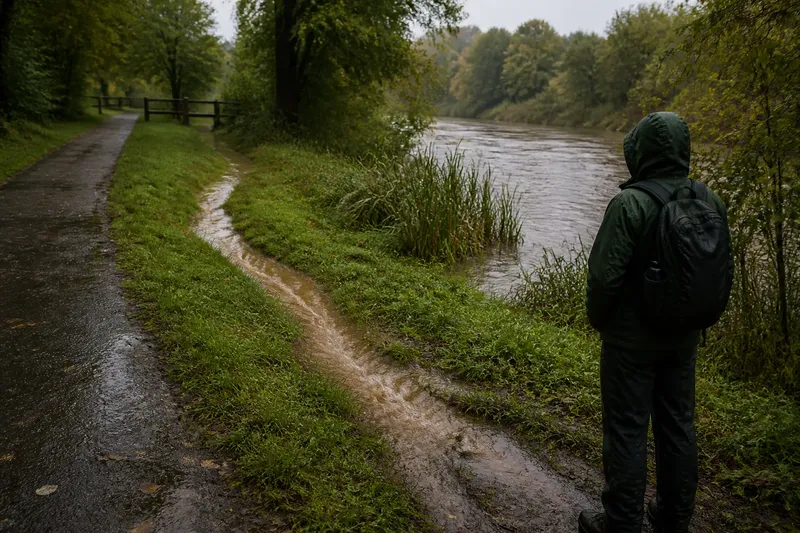
After rain, a narrow ribbon of water can appear across a path or field edge, then vanish into a stream. A rainy-day stream walk lets you follow clues like that without stepping into the channel or guessing where the water began. The most useful observations are simple: where water appears, what it carries, and where it goes.
What should I notice on a rainy-day stream walk?
Start from a stable public path or firm ground set back from the bank. Look for fresh runoff entering the stream, changes in the water’s appearance, and places where raindrops or incoming flow disturb the surface.
Record only what you can see. “A narrow muddy thread enters below the footbridge” is more useful than deciding that a particular hillside caused it when you have not traced the route.
How can I trace runoff without leaving the path?
Follow the visible route of water across the landscape with your eyes. It may run along a curb, collect in a shallow dip, pass through a gap in vegetation, or disappear beneath a culvert before reaching the stream.
Do not assume that every wet patch connects to the channel. A puddle may have no visible outlet, and a drain’s destination may be hidden. Note where the trace starts and ends in view, then mark any gap as unknown.
What can a stream’s color tell me after rain?
Water that looks cloudy or discolored may contain suspended material, but color alone cannot identify what it is or where it came from. Compare separate parts of the stream from the same safe viewpoint: perhaps a narrow inflow looks darker than the main channel, or the water is uniformly cloudy.
Describe the appearance and location rather than assigning a cause. Avoid collecting a sample or touching the water; a visual record is enough for a casual observation.
How do I record changes without turning clues into claims?
Use a short note with four parts: where you stood, what you saw, where it moved, and what remains uncertain. If you visit the same spot again, compare like with like—for example, the same bank-side view after rain has eased—rather than treating one observation as a long-term pattern.
- Check whether the path or ground is firm; if it is slippery, flooded, or eroding, then turn back and choose a safer viewpoint.
- Check whether a runoff thread has a visible route; if it reaches the stream in view, then note the meeting point, but if its route disappears, record the gap as unknown.
- Check whether the water’s color differs between the inflow and the main channel; if it does, then describe where the contrast appears, but if it does not, note that the water looks similar from your position.
- Check whether floating leaves or foam move across a visible patch; if they do, then note their direction, but if they stay still or swirl locally, avoid calling that the stream’s overall direction.
- Check whether the water is rising toward a recognizable bank feature; if the level seems to be changing, then observe only from farther back, but if you cannot tell, leave the water-level change unrecorded.
- Check whether your view includes the source and outlet of a drain; if either is hidden, then describe only the visible section, but if both are visible, note the route without inferring what lies beyond it.
Say you stand on a paved public path after a shower and see a thin, brownish ribbon cross a grassy dip toward a stream. You note the path location, describe the ribbon as visibly cloudy, and watch it disappear behind a screen of reeds before the channel; because its final route is hidden, your record says “runoff approaches the stream; entry point not visible.” That is a more defensible account than naming a source you did not observe.
It is not worth chasing a trickle through wet vegetation, probing a drain, or trying to identify every fleck in cloudy water. Those efforts add risk and speculation while a clear note from the path preserves the useful clue.
How can I stay safe while watching a stream?
Stay on a public path or stable ground well back from the edge. Wet banks can be slippery or undercut, and fast water may be dangerous even when the channel looks shallow.
Do not visit close to a flooded stream or during heavy rain. If a path is inundated, the bank is crumbling, or water is moving quickly, turn around and observe from a safer place another time.
What questions come up on a rainy-day stream walk?
Can I tell where runoff came from?
Only if you can see its route clearly from a safe vantage point. If the trace vanishes under vegetation, pavement, or a culvert, record the visible section and leave its source uncertain.
Does cloudy water prove that a bank is eroding?
No. Cloudiness shows that material is suspended in the water, but appearance alone cannot establish its source. Describe where the water looks cloudy without assigning a cause.
Should I walk beside the stream during heavy rain?
No. Rising water, slick ground, and flooded paths can make close observation unsafe. Choose a stable viewpoint well back from the channel, or return after conditions improve.
What should I write down after the walk?
Note your viewing place, visible water routes, appearance, and uncertainties. If you return to the same spot, those details give you a fair basis for comparing what you can see.
What makes a stream note useful later?
A rainy-day stream walk becomes easier to compare when notes separate observation from interpretation. Record the visible route and conditions in plain language, and let the unknowns stay unknown.
Keep the note brief enough to use again: the vantage point, the runoff trace, and the point where it disappears. On a later visit, that record can help you see whether the same path carries water again without disturbing the stream or claiming more than the view supports.