Beach or Rocky Shore: Two Different Clues to Coastal Change
Compare a sandy beach and rocky shore as records of coastal change, using grains, ledges and fresh deposits to read what waves have altered.
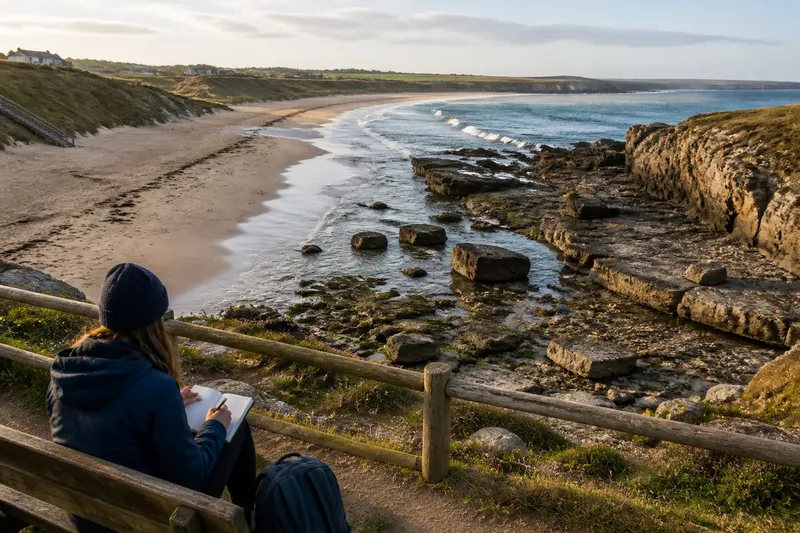
To read coastal change, start by asking what the shore is made of: loose sand or exposed rock. A beach or rocky shore records waves in different ways because grains can be picked up and moved, while solid rock usually changes through cracking, wearing and collapse. The contrast becomes clearer when you inspect a stretch of coast in a consistent order, from the landward edge toward the water.
What should you notice before looking for change?
Choose a safe place where you can see a useful length of shore without approaching breaking waves, unstable cliffs or slippery ledges. Observe from a public path, a stable beach entrance or another permitted viewpoint. A single visit is a snapshot, not a record of what happened between tides or seasons.
Before interpreting shapes, note the conditions that can alter what is visible: tide level, recent rough weather, wind direction, and whether the beach is wet or dry. You do not need elaborate gear. A notebook, a phone camera and a fixed landmark—such as a stairway, groyne or prominent rock—can help you describe the same view consistently on a later visit.
Look for the shore’s material and arrangement. Sand may form a broad, gently sloping surface, while pebbles, shells and driftwood can mark recent deposits. A rocky shore may show platforms, pools, cracks, detached blocks or a steep face. These are observations; deciding what caused them requires care.
How does a sandy beach record movement?
A sandy beach is made of particles that waves and currents can shift. The shore’s outline may appear smooth, but the material is continually rearranged: waves can carry grains up the beach, pull them downslope, or move them along the coast. A change in the visible width or slope may reflect this redistribution, rather than the creation or loss of all the sand in that spot.
Read the beach in zones. Near the water, look for a wet strip, small ridges, shallow runnels and the edge of the swash—the area reached by waves. Higher up, notice berms, wrack lines of seaweed or other debris, and the transition to dunes or a seawall. A newly distinct line of shells or seaweed may show where water reached under particular conditions, but it does not by itself establish a lasting shift in the shoreline.
Compare the same fixed landmark and viewpoint on another occasion. If the beach looks narrower, check whether the tide is higher, whether the wet edge has moved, and whether a ridge or deposit has changed. A lower tide can reveal a wider expanse without any durable gain in beach material; rough conditions can also temporarily steepen or flatten the profile.
Imagine a visitor who sees a broad beach at low tide one day and a narrow strip at a higher tide on a later visit. If the dry-sand edge and the wrack line remain in similar places relative to a stairway, the first explanation to consider is the different water level, not sudden coastal retreat. Returning under comparable conditions would make the comparison more informative.
What does exposed rock reveal differently?
Rock does not flow around like sand. Its visible record often lies in the shape of the rock itself: a wave-cut platform, a notch at the base of a cliff, joints and cracks, or blocks that have separated from a face. Waves can exploit weaknesses, while weathering can loosen material; over time, pieces may break away and be moved elsewhere.
Notice how features relate to one another. A notch may occur near the level where waves commonly reach the shore, while a crack may continue upward through a cliff or across a platform. Detached blocks can be angular or worn, but their appearance alone cannot tell you exactly when they separated or how far they traveled. Rock type, exposure, and local conditions all shape the clues.
Rocky shores can also hold small sediment deposits between ledges or in coves. Pebbles lodged in a hollow, sand trapped behind a rock rib, or fresh-looking debris may show how water moves through the local landform. These deposits are not a contradiction: a rocky coast can include mobile material, just as a sandy coast can contain bedrock beneath the beach.
Do not treat a single broken block or a clean-looking ledge as proof of a recent event. A fresh face may result from an older break that has not yet weathered much, and a wave-washed surface can look newly exposed after ordinary changes in water level. The useful clue is how several features fit together and whether their positions change across repeated observations.
How can you compare the two shore types fairly?
Use the same sequence on each visit, and describe what you can see before naming a cause. A short record might include:
- Shore material: note sand, gravel, exposed bedrock or a mixture.
- Viewpoint and landmark: identify where you stood and what fixed feature anchors the scene.
- Water conditions: record whether the tide is rising or falling if known, and note visible wave or wind conditions.
- Deposits: describe ridges, wrack lines, pebbles or sediment caught in hollows.
- Landform clues: note beach slope and berms, or rock notches, platforms, cracks and detached blocks.
- Visible difference from before: state precisely what moved, appeared or disappeared, rather than writing only “more erosion.”
Photographs can help when taken from a stable, repeatable viewpoint. Frame the landmark and the shore together so that a later image can be compared with the earlier one. Avoid judging change from images made at very different tides, angles or lighting; shadows can exaggerate a ledge, while wet sand can look darker and narrower than dry sand.
For a beach, compare deposits and the landward edge as well as the waterline. For rock, compare the position and outline of cracks, notches and blocks. The distinction matters because loose sediment can shift visibly and return, whereas a fractured or removed rock face may represent a more durable change. Neither material gives a complete account from one glance.
Which questions help interpret what you see?
Does a narrower beach mean the coast is retreating?
Not necessarily. Tide, recent wave conditions and the movement of sand can change the visible beach width without establishing a lasting shoreline trend. Compare observations made from the same place under similar conditions before drawing a broader conclusion.
Can a rocky shore change even when it looks solid?
Yes. Cracks may widen, blocks may separate, and waves can wear exposed surfaces gradually, even when a visit reveals no dramatic break. Repeated views of the same feature are more useful than expecting a large change to be obvious at once.
Why does a beach sometimes sit beside a rocky platform?
Different materials can occur close together because landforms vary along the coast and sediment may collect in sheltered gaps or coves. The beach records mobile grains, while the platform records the shape and condition of the underlying rock.
What is not worth the effort when reading a shore?
It is not useful to infer a precise history from one shell line, one loose boulder or one photograph taken at an unknown tide. Nor does repeatedly measuring the water’s edge from changing viewpoints add much clarity. A careful description tied to a fixed landmark is a better starting point.
How should you make a cautious reading?
Build an interpretation from several clues. On sand, ask whether ridges, wrack lines and the upper beach have shifted together, or whether only the waterline differs. On rock, ask whether cracks, notches and detached material form a coherent pattern, and whether a later observation shows any clear change.
Keep observation separate from explanation. “A new-looking pebble deposit lies behind the outer ledge” is more precise than “the coast is advancing”; “a crack is visible above the platform” says more than “the cliff is collapsing.” Careful wording leaves room for other causes, including tide, wave direction, sediment supply and the natural variety of the shore.
When you compare a beach or rocky shore as a record of coastal change, the material tells you what kind of clue to seek: movement and rearrangement in loose sediment, or wear and fracture in solid rock. Keep the viewpoint and conditions in mind, then return to the same features when you can. A shore may look different from one visit to the next; the lasting story emerges from what changes repeatedly, and what stays put.